Bed bugs are not one problem, they are five. Eggs, four nymph stages and mature adults all live in the same room at the same time, often in different places and at different depths. That is the reason so many London infestations survive spray after spray: a treatment that only reaches the bugs walking on the surface leaves the next generation cemented into a seam, ready to hatch a week later.
A recent job we attended in London was a textbook example. The occupant had already tried two rounds of chemical treatment through a managing agent, and was still waking with fresh bites. What they were seeing was not a failed kill, it was an incomplete one.
What the inspection actually found
Our inspection started with the bed and worked outwards. On the mattress piping we found live adults and the classic dark fecal spotting. Behind the headboard, in the slot where the fixings sit, there was a dense harbourage: shed skins from several moults, translucent eggs stuck to the timber, and small pale nymphs that had recently fed.
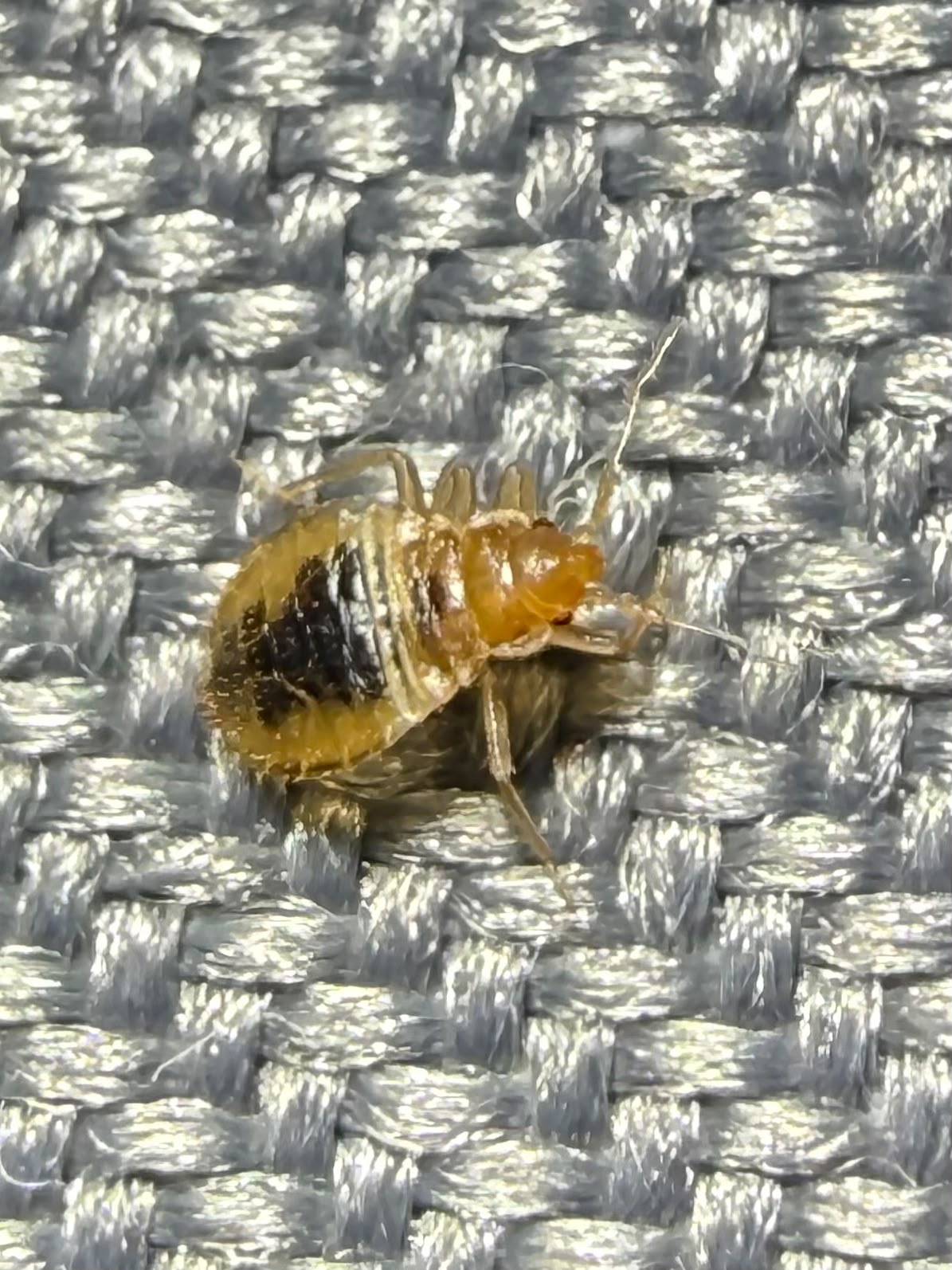
The macro photograph on this page is from the same category of find — an engorged bug on woven fabric, its abdomen dark with a recent blood meal. That single image tells you two things: the bugs are feeding successfully, and they are breeding. A feeding female lays several eggs a day.
Evidence was also present in a bedside drawer, along the carpet gripper rod at the skirting, and inside the seam of an upholstered chair three metres from the bed. That spread is normal in London flats, where beds sit tight against walls and furniture is rarely moved.
Why eggs are the reason infestations come back
Bed bug eggs are roughly a millimetre long, glued in place, and largely unaffected by residual insecticide. They also do not respond to bait or to disturbance. A spray programme relies on newly hatched nymphs walking across treated surfaces before they hide, which is exactly what does not happen when the harbourage is inside a hollow bed frame or under a carpet edge.
Heat does not care where the egg is. It only cares that the material around it reaches lethal temperature and stays there. That is a completely different way of attacking the problem, and it is why heat treatment closes the door on re-infestation from within the property.
How the heat treatment was carried out
We set industrial heaters outside the property and ducted heated air into the rooms, then sealed and monitored the space:
- Furniture, beds and soft furnishings were loosened and opened so air could circulate rather than skim past.
- Wireless probes were placed in the worst harbourages — inside the bed frame, under the mattress, behind the headboard and at the skirting — not just in the middle of the room.
- Air temperature was brought up steadily and the room was held in a monitored soak so that the core of every item, not just its surface, reached lethal temperature.
- Thermal imaging was used through the treatment to find cold spots, and ducting was repositioned to push heat into them.
- Fans kept air moving so cupboards, drawer runners and wall voids were not left as cool refuges.
The critical detail is the soak, not the peak. A room that touches a high number briefly has not treated the inside of a mattress. Sustained, verified temperature at the harbourage is what kills eggs, nymphs and adults together in one pass.
Preparation and aftercare in a London flat
Prep for this job was straightforward, and we walk every customer through it: bag and remove aerosols, pressurised canisters, candles, medication, alcohol, pets, plants and fish tanks; leave wardrobes and drawers accessible; do not start moving infested items between rooms.
Afterwards, the room is aired and cooled before it is handed back. Clothing does not need washing again once it has been through the treated space. We advise leaving furniture pulled slightly away from walls for a few days, using light-coloured bedding so any new evidence is obvious, and reporting anything at all rather than waiting.
For a flat in a converted London terrace we also check adjoining rooms, because bed bugs travel along service runs and shared voids. Treating one bedroom while ignoring the neighbouring one is how a property gets re-infested from next door.
Why heat worked where spraying had not
Three reasons, all simple:
1. It reached every life stage in the same visit, including eggs. 2. It penetrated harbourages that no spray can wet — inside frames, under carpet edges, deep in upholstery. 3. It left no residue, so the room was usable again the same day.
Follow-up monitoring on this property found no live activity and no new bites. One visit, one verified kill, no ongoing chemical programme.
Get a free quote for bed bug heat treatment in London
If you are dealing with bites that keep coming back after spraying, the problem is almost certainly the life stages that were never reached. Contact Emergency Heat Treatments for a free quote and honest advice on whether heat treatment is right for your property. We cover London and the surrounding areas with rapid response wherever possible.